
The evidence behind the standard.
Everything claimed about Manapol® powder comes from somewhere. This page shows where: who ran the testing, what methods they used, what the results were, and which published literature the science rests on.
An independent university lab, not our own.
The analytical data on this page was generated by the Complex Carbohydrate Research Center at the University of Georgia.
The CCRC is an academic research center specializing in the structural analysis of complex carbohydrates — the exact class of molecule acemannan belongs to. Mannatech commissioned and paid for this analysis, as is standard for third-party ingredient testing. We send samples; the laboratory reports what it finds.
We believe in transparency. Testing instills consumer confidence and helps verify that Manapol® powder meets established specifications, ensuring product consistency.
Two methods, two different questions.
Aloe powder can be characterized in a lot of ways. These two answer the questions that actually determine whether a powder contains acemannan.
Molecular weight by Size Exclusion Chromatography (SEC)
Abbreviated SEC. The sample is passed through a column packed with porous beads. Small molecules wander into the pores and take longer to come out; large molecules can't fit and pass straight through. Sorting by exit time sorts the sample by molecular size.
This is what tells you how much of a powder sits in the 1–2 million Dalton range — the range that defines acemannan.
Glycosyl Analysis (Sugar Profile) by GC-MS
Glycosyl Analysis (Sugar Profile) is performed by gas chromatography-mass spectrometry (GC-MS). The polysaccharides are broken down into their individual sugar units, which are then identified and measured one by one.
Glycosyl analysis shows the saccharides that are present at detectable levels. In Manapol® powder, that is nine.
Acemannan is a defined substance.
"Acemannan" is not a general term for aloe extract. It is a name with a specification attached.
The Chemical Abstracts Service — a division of the American Chemical Society — and the United States Adopted Names Council define acemannan by molecular weight, at 1 to 2 million Daltons. A Dalton is a unit of molecular mass; one million Daltons describes a very large polymer, not a simple sugar.
That definition is the reference point for everything on this page. When we report how much of Manapol® powder falls in the 1–2 million Dalton range, we are reporting how much of it meets the published definition of the substance it claims to be.
We cite the published standard rather than paraphrasing it, so you can check it yourself.

What the report came back with.
The numbers below are those published in the report from the Complex Carbohydrate Research Center.
| Measure | Method | Result |
|---|---|---|
| Fraction at 1–2 million DaltonsThe range defining acemannan | SEC | ≥43% |
| Total polysaccharide contentProportion of the powder that is polysaccharide | SEC | 67% |
| Distinct saccharides detectedIndividual sugars identified in the sample | Glycosyl analysis | 9 |
| Saccharide | Note | Proportion |
|---|---|---|
| Mannose | Backbone of the acemannan polymer | 64.7% |
| Galacturonic acid | Indicates an aloe pectin structure | 13.8% |
| Glucose | — | 7.1% |
| Galactose | — | 4.9% |
| Xylose | — | 3.9% |
| Rhamnose | — | 1.7% |
| Arabinose | — | 1.6% |
| Glucuronic acid | — | 1.2% |
| Fucose | — | 1.1% |
Testing performed by the Complex Carbohydrate Research Center, University of Georgia. Molecular weight by size exclusion chromatography; monosaccharides by glycosyl analysis.
A polysaccharide's size changes where it goes.
Molecular weight is not a vanity metric. It determines how far a polysaccharide travels before the body breaks it down — and different distances mean different functions.*
The large fractionToo big to be absorbed high in the digestive tract. It travels the length of the intestine, where it can act as a prebiotic substrate supporting beneficial microbial activity.*
The smaller fractionAbsorbed higher up and able to enter circulation, where smaller saccharide structures participate in cellular recognition and communication.*
Manapol® powder is a broad-spectrum, polydispersed product derived from aloe vera, meaning it contains aloe saccharides across various molecular weights with a significant portion reaching 1–2 million Daltons. It is the cold processing and ethanol precipitation that preserve the polysaccharides — most importantly acemannan.
The report itself.
A substantiation page should be able to name the document it rests on. These are the identifying details of the analysis published above.
| Report date | 12/06/2022 | |
|---|---|---|
| CCRC code | TS111122D | |
| Project title | Glycosyl composition analysis and determination of the molecular weight of Manapol CRMANE291102 | |
| Sample analyzed | Manapol: CRMANE291102 | |
| Principal investigator | Tait Switzer, Mannatech, Incorporated — 1410 Lakeside Parkway, Flower Mound, TX 75028, United States | |
| Report prepared by | Artur Muszynski, PhD, MSc | |
| Report reviewed by | Christian Heiss | |
| Methods | Glycosyl Analysis (Sugar Profile) by gas chromatography-mass spectrometry (GC-MS); molecular weight by Size Exclusion Chromatography (SEC) | |
| Funding | Analysis commissioned and paid for by Mannatech, Incorporated | |
This work was analyzed by The Complex Carbohydrate Research Center of the University of Georgia and was supported by the U.S. Department of Energy, Office of Science, Basic Energy Sciences, Chemical Sciences, Geosciences and Biosciences Division, under award #DE-SC0015662.
Now you've seen the receipts.
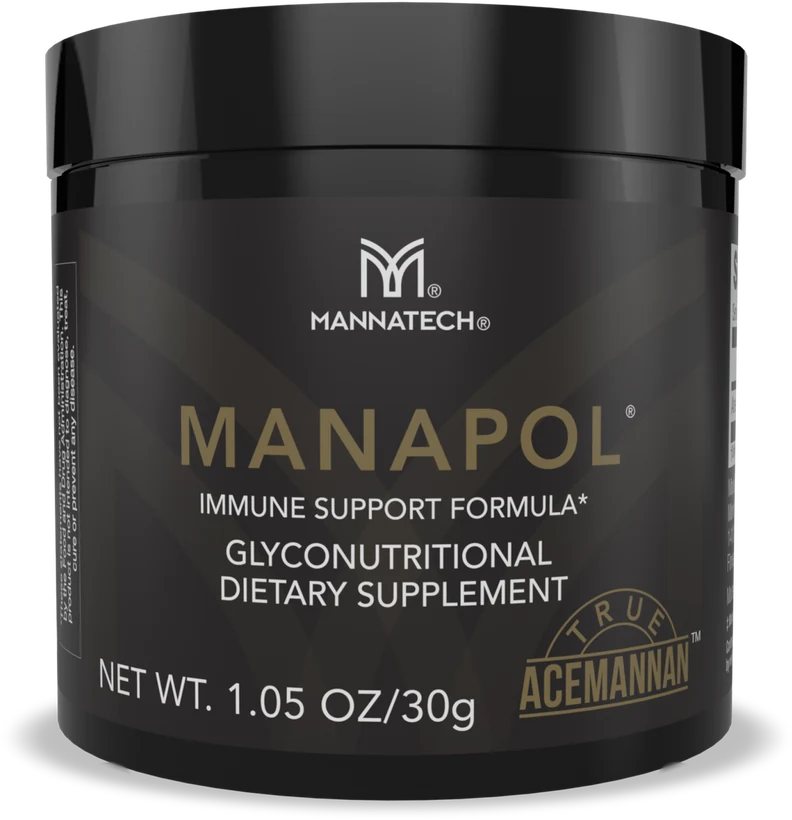
Manapol® powder — 500 mg per scoop, held to the same specification batch after batch.
* These statements have not been evaluated by the Food and Drug Administration. This product is not intended to diagnose, treat, cure or prevent any disease.
This work was analyzed by The Complex Carbohydrate Research Center of the University of Georgia and was supported by the U.S. Department of Energy, Office of Science, Basic Energy Sciences, Chemical Sciences, Geosciences and Biosciences Division, under award #DE-SC0015662. Analysis commissioned and paid for by Mannatech, Incorporated.
The 1–2 million Dalton definition of acemannan was set forth by the Chemical Abstracts Service (CAS), a division of the American Chemical Society, and the United States Adopted Names Council (USAN), a division of the American Medical Association.
Claims basis: Approved U.S. Manapol® Powder Claims, December 13, 2021 (supersedes September 2017), product number 15601.
Manapol® is a registered trademark. Ambrotose® and Ambrotose LIFE® are trademarks of Mannatech, Incorporated. Mannatech asserts common law trademark rights in the stylized True Acemannan design.