
Acemannan has a definition.
Most aloe never reaches it.
The Chemical Abstracts Service and USAN define acemannan by molecular weight: 1 to 2 million Daltons. That number isn't marketing language — it's the published line between acemannan and everything else sold as aloe. Manapol® powder was built to clear it.
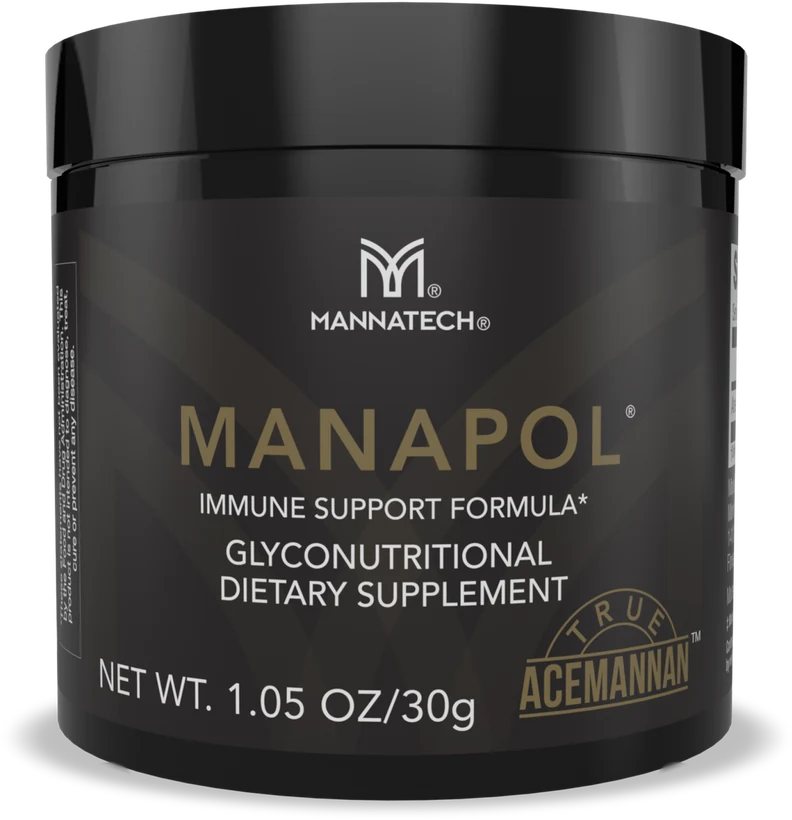
One number decides what counts.
Aloe is mostly water. What's left after processing is where products separate — and the separator is size. Molecules large enough to meet the acemannan definition survive the digestive tract differently than small sugar fragments do.* So Mannatech commissioned an independent university laboratory to measure exactly what is in Manapol® powder, and published what came back.
1–2 million Daltons — the acemannan definition
≥43%Total polysaccharide content
67%Distinct saccharides detected by glycosyl analysis
9Measured by SEC and glycosyl analysis · Complex Carbohydrate Research Center, University of Georgia
Acemannan — the acetylated mannan of the aloe inner leaf. Schematic; not to scale.
What a million Daltons actually means
A Dalton is a unit of molecular mass, and the number only means something next to other numbers. Here is the same scale applied to things you already know.
Circle sizes are illustrative and not proportional; the true difference is far larger than any diagram can show.
We publish the whole analysis.
Aloe quality isn't one number — it's the whole sugar profile. Glycosyl analysis shows the saccharides present at detectable levels. In Manapol® powder that is nine, led by mannose rather than glucose, and including galacturonic acid, which indicates the presence of aloe pectin.
Glycosyl Analysis (Sugar Profile) performed by gas chromatography-mass spectrometry (GC-MS).
Molecular weight performed by Size Exclusion Chromatography (SEC). Testing commissioned and paid for by
Mannatech, Incorporated.
This work was analyzed by The Complex Carbohydrate Research Center of the University of Georgia and was
supported by the U.S. Department of Energy, Office of Science, Basic Energy Sciences, Chemical Sciences,
Geosciences and Biosciences Division, under award #DE-SC0015662.
The profile survives because of what we leave out.
The special process by which Manapol® powder is harvested and processed may provide for a more effective source of glyconutrients. Leaves are hand-harvested and hand-filleted to protect the inner leaf gel, then cold-processed — a method chosen to preserve structure rather than speed throughput.
01
Hand-harvested Leaves are cut by hand on the plantation, not machine-stripped.02
Hand-filleted The outer rind is removed by hand so the inner gel is never crushed.03
Inner leaf gel only Just the fillet moves forward, leaving the outer leaf behind. Low in aloins.04
Cold-processed Cold processing and ethanol precipitation together preserve the polysaccharides — most importantly acemannan.05
Manapol® powder Standardized, stabilized, and held to specification batch after batch.A single source, chosen for its soil.
Manapol® powder is the standardized, stabilized aloe vera extract at the center of every Ambrotose® formula, grown in the volcanic soils of Costa Rica and hand harvested. It includes a standardized amount of the very high molecular weight acemannan polysaccharides — 1 to 2 million Daltons, as defined by the American Chemical Society — and every batch is tested and confirmed to contain it.
Natural Aloe de Costa Rica produces Manapol® powder to specifications agreed exclusively with Mannatech. It is one of the few aloe materials carrying the broad spectrum of mannans up to and including acemannan at 1 to 2 million Daltons, and among the aloe Mannatech has tested, the NACR plant is the only source shown to carry all nine saccharides.
It comes from one place: the plantations of Natural Aloe de Costa Rica, from whom Mannatech sources all of its aloe. Rich volcanic soil, clean air, and a consistent tropical climate produce leaves that a temperate greenhouse can't replicate — and six decades of agronomy, genetic work, and cross-pollination have been spent refining the plants themselves.
The plantation runs on a 100% carbon-free footprint, generating its own electricity from biomass. It is not a commodity aloe supply. It is a specific farm, a specific plant stock, and a specific process, held to the same specification batch after batch.


It is not a commodity aloe supply. It is a specific farm, a specific plant stock, and a specific process.
Immune support, and what sits behind it.
Immune support
Supports a healthy immune system and your body's natural immune response.* Supports healthy immune system function through its acemannan content.*
Digestive and gut health
Supports healthy microbiome balance and helps support proper digestive system function.* Larger polysaccharides are more likely to reach the lower digestive tract, where they can support beneficial microbial activity.*
A source of glyconutrients
Manapol® powder is a source of glyconutrients and is rich in acetylated mannans — the acemannan family of saccharides the aloe leaf produces.
Blood lipid and blood sugar
Supports blood lipid levels that are already in the normal range.* Supports blood sugar levels that are already in the normal range.*
Cellular communication
Supports cellular communication.* Acemannan is a source of glycans — the plant saccharides cells use to recognize one another and pass signals back and forth.*
Clean by formulation
100% aloe. Pure, naturally sourced and synthetic-free. Naturally gluten-free, non-GMO, and suitable for vegetarians and vegans. No additives or excipients, no artificial flavors or colors, no preservatives, no MSG. Free of common allergens — soy, dairy, shellfish and peanuts. Not irradiated, low in aloins, and low glycemic.
Simple to take
One scoop (500 mg) mixed with food or water, one to two times daily. Shake the canister before each use — the contents settle during shipping.
The ingredient, and the foundation.
Manapol® powder is a Mannatech product you can take on its own. It is also the aloe foundation beneath our flagship multi-glycan formulas.
Manapol® powder — 500 mg per scoop of standardized, stabilized aloe vera extract, for people who want acemannan directly.
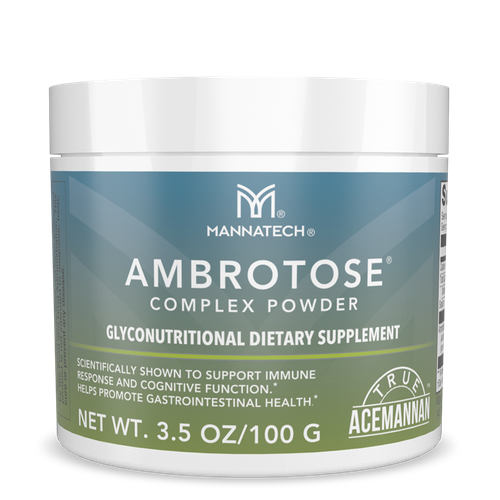
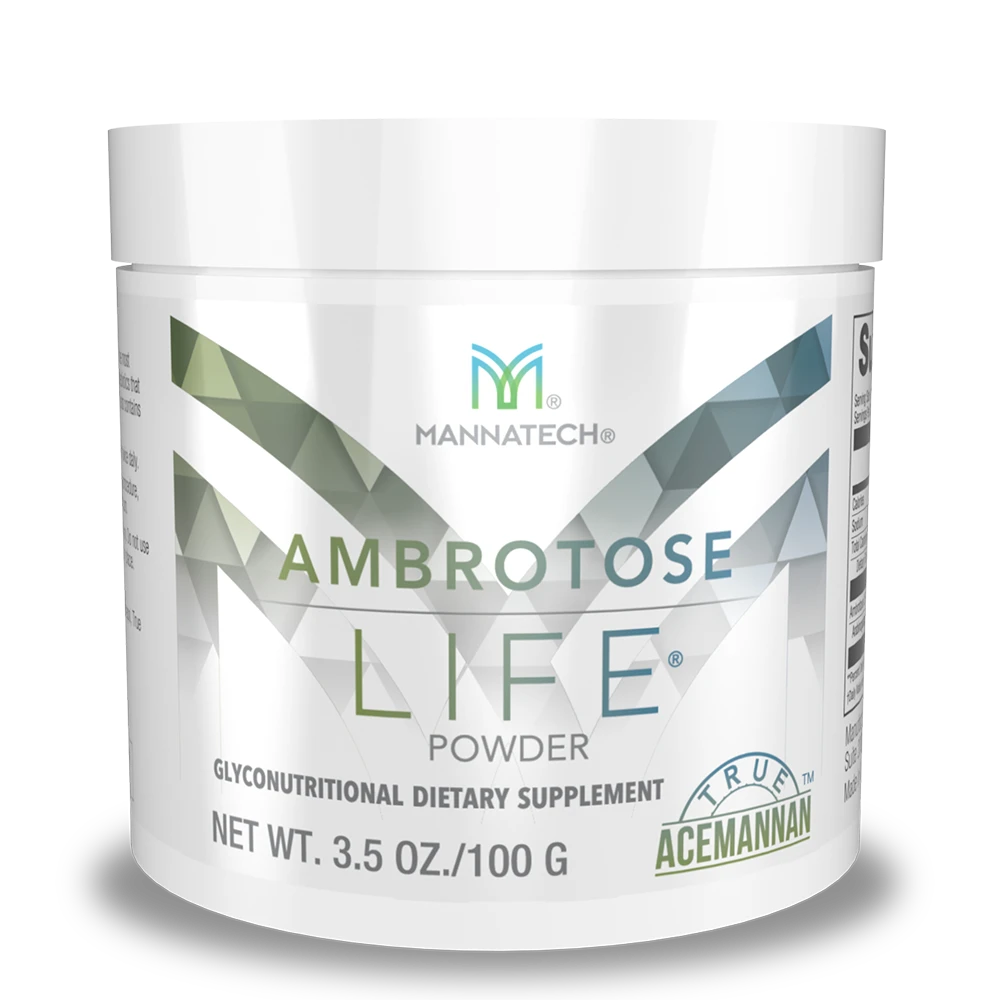
Ambrotose® Complex powder and Ambrotose LIFE® powder are built on Manapol® powder, combined with a multi-source saccharide base.
A formula is only as good as its foundation. Holding Manapol® powder to a published specification is what makes everything built on it dependable.
Compare Ambrotose® Complex and Ambrotose LIFE® →The Quest for Manapol®: True Acemannan
Why Costa Rica's volcanic soil grows the aloe behind Manapol® — the only commercially available 100% pure aloe product with True Acemannan. From greenhouse to harvest to manufacturing.
Every purchase nourishes
a child in need.
Servings of PhytoBlend™ powder are provided to children in need with the purchase of this product.
The details.
What is acemannan, exactly?
Acemannan is the acetylated mannan found in the inner leaf gel of the aloe vera plant — a long-chain saccharide the cell membrane uses to support cellular recognition and communication.* It has a formal definition: the Chemical Abstracts Service and USAN define acemannan as requiring a molecular weight of one million Daltons or more.
What is a Dalton, and why does molecular weight matter?
A Dalton is a unit of molecular weight. It matters because the mechanism of action for saccharides depends heavily on molecular weight and structure. Larger polysaccharides are less likely to be absorbed high in the digestive tract and more likely to travel farther, where they can support beneficial microbial activity.* Smaller fragments behave differently.
Isn't all aloe basically the same?
No. Aloe is mostly water, and what remains depends entirely on the plant, the harvest, and the processing. Heat, enzymatic treatment, and charcoal filtration all change what survives. Two powders can both say "aloe vera" on the label and have very different analytical profiles. That's why we publish ours.
Aren't these just sugars? Will they raise my blood sugar?
Saccharide is the formal name for sugar, but most plant saccharides are not sweet and are not table sugar. Table sugar is a disaccharide; Mannatech does not use it in Manapol® powder. The saccharides here are specific plant-sourced structures selected for their role in cellular communication.*
Where does Manapol® powder come from?
From the Costa Rica plantations of Natural Aloe de Costa Rica, the only source from which Mannatech buys aloe — volcanic soil, clean air, and sixty years of agronomy. Leaves are hand-harvested and hand-filleted to protect the inner gel, then cold-processed with no heat, no enzymes, no charcoal, no additives, and no preservatives.
What should I ask about any aloe supplement?
Four questions will tell you almost everything. What percentage of the powder is actually polysaccharide? How much of it falls in the 1–2 million Dalton range that defines acemannan? How many distinct saccharides does an independent analysis detect? And who ran that analysis?
A company that has tested its material can answer all four. A company that hasn't will usually answer a different question instead — how fast it dissolves, how it's grown, how it's marketed. Those are worth knowing, but they aren't the same as knowing what's in the jar.
How much should I take?
One scoop (500 mg) mixed with food or water, one to two times daily. Shake the canister before each use — the contents settle during shipping.
Does Mannatech use aloe latex?
Manapol® powder is low in aloins — the compounds found in aloe latex. Only the inner leaf gel is used, and the fillet is separated by hand so the outer leaf is left behind.
I'm allergic to aloe vera. Can I take it?
Anyone with allergies or sensitivities to an ingredient should consult their personal physician before use. If you are pregnant, nursing, taking medication, have a health condition, or are planning a medical procedure, consult your health professional before use.
Manapol® powder or Ambrotose®?
Manapol® powder gives you acemannan directly. The Ambrotose® family builds on that same Manapol® foundation with a multi-source saccharide base designed to provide the broader spectrum of saccharides used in cellular communication.* Many people take both.

Know what's in your aloe.
Manapol® powder — 500 mg per scoop. Backed by an unsurpassable 180-day satisfaction guarantee.
* These statements have not been evaluated by the Food and Drug Administration. This product is not intended to diagnose, treat, cure or prevent any disease.
† The 1–2 million Dalton definition of acemannan was set forth by the Chemical Abstract Service (CAS), a division of the American Chemical Society, and the United States Adopted Names Council (USAN), a division of the American Medical Association.
Analytical data referenced on this page — molecular weight by size exclusion chromatography (SEC), percent polysaccharides, and monosaccharides by glycosyl analysis — was generated by the Complex Carbohydrate Research Center, University of Georgia.
This work was analyzed by The Complex Carbohydrate Research Center of the University of Georgia and was supported by the U.S. Department of Energy, Office of Science, Basic Energy Sciences, Chemical Sciences, Geosciences and Biosciences Division, under award #DE-SC0015662.
Claims basis: Approved U.S. Manapol® Powder Claims, December 13, 2021 (supersedes September 2017), product number 15601.
Manapol® is a registered trademark. Ambrotose®, Ambrotose LIFE®, PhytoBlend™ and Mission 5 Million® are trademarks of Mannatech, Incorporated. Mannatech asserts common law trademark rights in the stylized True Acemannan design.